How to Read an ECG
If you’ve ever visited a hospital or watched Grey’s Anatomy or Scrubs, you’ve probably seen an ECG. ECG stands for electrocardiogram, and it records the electrical activity of your heart. Sometimes it’s also called an EKG, which is just an abbreviation of the German spelling.
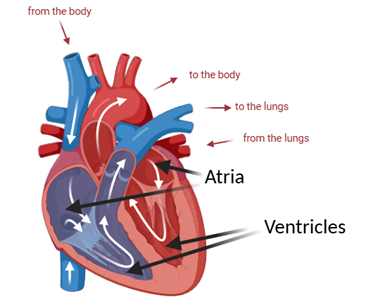
To be able to read an ECG, you first need to understand how the heart works. The heart is divided into four chambers. The two upper chambers are called the atria and the bottom are the ventricles. Blood from the body and the lungs enters the atria, which then pump the blood to the ventricles. Once the ventricles have had time to completely fill with blood, the muscle in the ventricles contracts, and the blood is pumped to the body and the lungs.
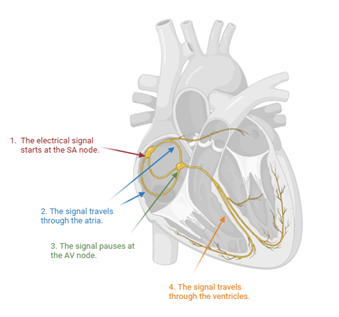
All of the muscle contraction is controlled by the electrical activity of your heart. Most of the muscles in your body are stimulated by electrical signals from nerves that are connected to your brain. The heart muscle is different. Instead of receiving signals from the brain and carrying that signal to the muscles with nerves, the heart has its own electrical system. The signals start at the top of the heart in specialized cells called the SA node, which creates a signal about 60-100 times a minute. From there, the electrical signals travel down through the atria, causing them to contract and pump blood into the ventricles. In between the atria and the ventricles is another group of specialized cells called the AV node. The AV node receives the electrical signal and pauses for a brief moment before sending the signal down into the ventricles. The pause allows there to be enough time after the atria contract for the ventricles to fill up with blood. The signal then goes through both ventricles, causing them to contract and pump blood to the lungs and the entire body.
The electrical signal has two parts. The first is called “depolarization” This is the signal that tells the heart muscle to contract. The second part is called “repolarization.” You can think of this as the electrical signal resetting. Depolarization and repolarization cause a spike to appear on the ECG. We call these spikes “waves” and they are given letter names. The first wave is called the R wave. The R wave measures the electrical activity during atrial depolarization. It means the electrical signal is passing through the atria. It is a small wave because the atria are smaller than the ventricles. After this signal passes through the atria there is a pause before the next wave. This is because the AV node is pausing which allows the blood to pass from the atria to the ventricles. The next wave is called the QRS complex. It is a lot larger than the R wave because the ventricles are a lot larger than the atria. The QRS complex measures the depolarization happening in the ventricles.
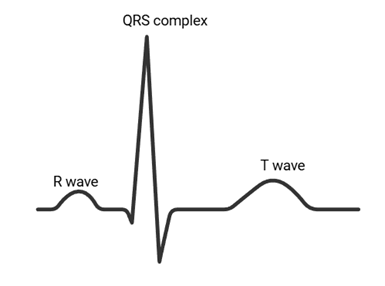
We can also see waves for repolarization, or resetting of the electrical signal. The atrial repolarization wave is very small and happens at the same time as the QRS complex, so we aren’t able to see it. We can see the ventricles repolarizing. This happens a few moments after the QRS complex and is called the T wave.
Why do we want to measure the electrical signals in the heart? It allows us to diagnose a lot of different heart problems. Sometimes the electrical signals in the heart can become dysfunctional. The signal might get stuck in part of the heart, or maybe it goes through a part of the heart it isn’t supposed to. This will cause changes to the ECG that can be used by cardiologists to figure out what is going wrong and where the problem is.
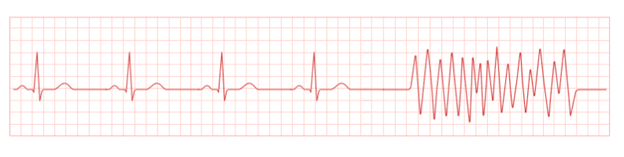
This ECG shows a normal heart beat that turns into an abnormal heart rhythm called ventricular fibrillation. This happens when the electrical signal stops coming from the SA node and instead is coming very quickly from a bunch of different cells in the ventricles. Without a regular, slow signal, the heart isn’t able to coordinate the contraction of the atria and ventricles, and they don’t have enough time to fill with blood. This causes a lot less blood to be pumped by the blood, and will quickly cause someone to pass out.
Another thing that can be seen on an ECG is a heart attack. During a heart attack, some of the heart muscle starts to die. This causes the heart to have problems with depolarization and repolarization, and this can be seen on the ECG.
The ECG is an easy way to quickly look for a lot of different heart problems. It’s used in doctor’s offices, emergency rooms, and ambulances. Now when you see an ECG on TV, you’ll be able to understand what it means!
Author
Emma Hudgins
ehudgins@udel.edu